

How Molecules Activate Cellular Signals and Influence Biological Responses
Hormones, neurotransmitters, peptides, and many modern medicines work by interacting with specialized structures called receptors. But what happens when a molecule reaches a receptor? How can something so small influence appetite, metabolism, hormone secretion, cardiovascular function, or cellular activity?
The answer begins with receptor signaling.
Small Molecule. Specific Receptor. Biological Response.
A receptor agonist is a molecule capable of binding to a receptor and activating it, initiating a biological response.
Understanding this interaction helps explain how many naturally occurring hormones work, and how scientists design increasingly precise therapies around the same biological systems.
What Is a Receptor?
To understand an agonist, we first need to understand the structure it interacts with: the receptor.
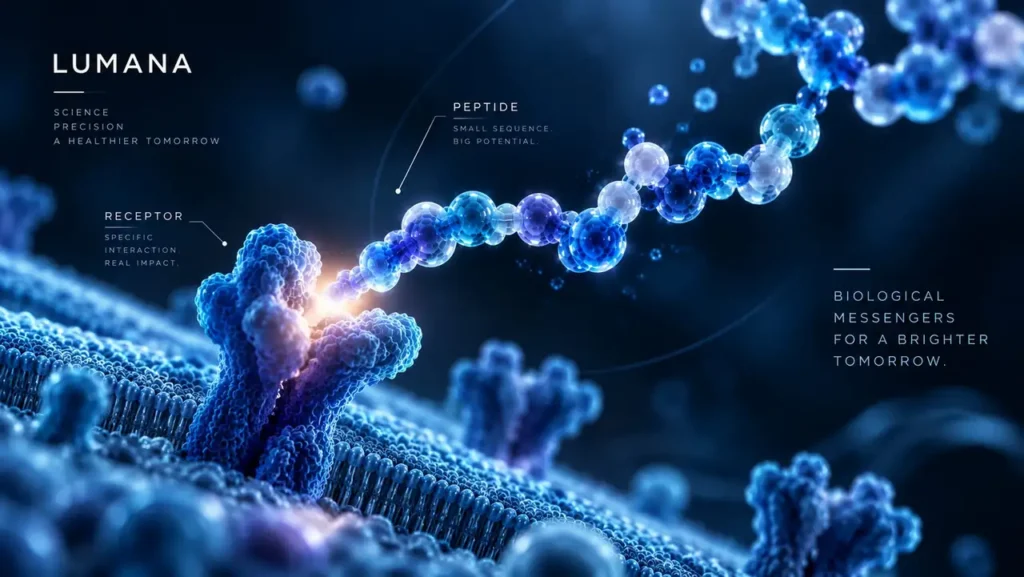
Receptors are specialized proteins that allow cells to detect and respond to chemical signals. These signals can include hormones, neurotransmitters, peptides, growth factors, medications, and many other molecules.
Some receptors are located on the surface of the cell, where they detect signals arriving from outside. Others are found inside cells. When the appropriate molecule interacts with its receptor, the receptor can change its activity and transmit information into the cell.
A familiar analogy is a key and lock. The molecule is the key. The receptor is the lock.
But biology is more sophisticated than a mechanical lock. Receptors are flexible, dynamic proteins. When a molecule binds to them, it can stabilize particular receptor shapes, or conformations, and different conformations can influence different signaling pathways. Modern receptor science therefore views receptors less like simple switches and more like highly sophisticated molecular communication systems.
What Is a Receptor Agonist?
An agonist is a molecule that binds to a receptor and activates it.
Once activated, the receptor can initiate a biological signal. That signal may influence metabolism, hormone secretion, appetite, heart rate, blood vessel function, nervous-system activity, immune signaling, or numerous other physiological processes.
An agonist does not necessarily create a completely new biological pathway. Many medicines are designed to interact with signaling systems that already exist in human biology.
For example, the body naturally produces hormones that activate receptors. Researchers can study these natural signaling molecules and develop compounds capable of interacting with the same receptors in more controlled or longer-lasting ways.
Degrees of Agonism
- A full agonist may produce the receptor system’s maximal response under a given experimental setting.
- A partial agonist activates the receptor but may produce a lower maximal response.
- A biased agonist may favor certain signaling pathways associated with a receptor over others.
How Does Receptor Activation Work?
Imagine a peptide hormone circulating through the bloodstream. Eventually, it reaches a cell containing a receptor capable of recognizing it.
- RecognitionThe signaling molecule encounters a compatible receptor.
- BindingThe molecule binds to a particular region of the receptor.
- ActivationThe receptor changes its molecular configuration.
- Cellular SignalingThe activated receptor communicates with signaling machinery inside the cell, producing downstream effects.
AgonistReceptorSignalBiological Response
The same signaling molecule can produce different effects in different tissues. The surrounding biology matters.
Agonists vs. Antagonists
Agonists and antagonists can interact with the same biological systems, but they behave very differently.
Agonist
Binds to a receptor and activates it.
Binding → Activation → Signal
Antagonist
Binds to a receptor but does not activate it in the same way. It can prevent or reduce activation by an agonist.
Binding → Blocking → Reduced signaling
Beyond On and Off
Modern receptor science extends far beyond simple ON and OFF switches. Inverse agonists, allosteric modulators, partial agonists, biased agonists, and other pharmacological behaviors add additional layers of complexity.
Why Receptor Selectivity Matters
One of the major goals of modern drug development is selectivity.
A molecule that interacts strongly with one receptor but minimally with unrelated receptors may produce a more focused biological effect. Selectivity can influence efficacy, side effects, duration of action, tissue response, and overall pharmacology.
But selectivity is not always absolute. A compound can interact with multiple receptor families, and sometimes that is intentional. This has led to an increasingly important area of biotechnology: multi-receptor agonism.
Peptides and Receptor Signaling
Peptides are particularly important in receptor biology because many naturally occurring peptides function as biological messengers.
Many peptide hormones communicate by binding to receptors located on the cell surface. The receptor then transmits the message into the cell.
Many peptide receptors belong to a large family known as G protein-coupled receptors, or GPCRs. GPCRs are among the most important receptor families in biology and pharmacology and can activate complex intracellular signaling networks after a ligand binds.
However, not every peptide hormone uses a GPCR. Insulin, for example, signals primarily through the insulin receptor, which belongs to the receptor tyrosine kinase family. This is why it is important not to treat every peptide or receptor system as biologically identical.
Peptide HormoneCell-Surface ReceptorIntracellular SignalingPhysiological Response
Single, Dual, and Triple Agonists
One of the most interesting developments in modern metabolic science is the design of molecules capable of activating more than one receptor.

Single Agonist
Primarily designed to activate one receptor. A selective GLP-1 receptor agonist, for example, primarily targets the GLP-1 receptor.
Dual Agonist
A single molecule can activate two receptor systems. Tirzepatide acts as an agonist at both the GIP receptor and GLP-1 receptor.
Triple Agonist
A molecule can be engineered to interact with three receptor systems. Retatrutide is an investigational GIP/GLP-1/glucagon receptor agonist and is not FDA-approved as of October 2026.
The Central Question
A central question in modern pharmacology is no longer only which receptor should be targeted, but whether multiple biological signals can be coordinated within one molecule.
The Future of Receptor-Based Science
The future of receptor pharmacology may become increasingly precise.
Scientists are no longer studying only whether a molecule activates a receptor. They are also asking which receptor conformation it stabilizes, which intracellular pathway it favors, how strongly it activates the receptor, how long the signal persists, and which tissues receive the strongest signal.
This is where concepts such as biased agonism become especially interesting. A receptor may be capable of activating several downstream pathways, and researchers are exploring whether molecules can be designed to favor particular signaling pathways while minimizing others.
Future drug development may therefore involve much more than simply finding molecules that turn receptors on. It may involve controlling where, how strongly, for how long, and through which signaling pathway a receptor communicates.
From Molecule to Message
Receptor agonism reveals one of the most elegant aspects of biology. A microscopic molecule can interact with a microscopic receptor and initiate a signaling cascade capable of influencing an entire physiological system.
MoleculeReceptorSignalResponse
But the molecule alone is only part of the story. The receptor matters. The tissue matters. The signaling pathway matters. The duration of activation matters. And ultimately, the evidence matters.
Lumana · Science. Precision. A Healthier Tomorrow.
Frequently Asked Questions
What is a receptor agonist in simple terms?
A receptor agonist is a molecule that binds to a receptor and activates it, initiating a biological signal.
Is an agonist always a peptide?
No. Agonists can belong to many different molecular classes, including peptides, small molecules, neurotransmitters, hormones, and other compounds. “Agonist” describes what the molecule does at a receptor, not what the molecule is made from.
Are all peptides receptor agonists?
No. Some peptides activate receptors, but peptides can have many different biological roles. The terms peptide and agonist describe different characteristics.
What is the difference between an agonist and an antagonist?
An agonist activates a receptor. An antagonist generally binds to the receptor and reduces or prevents activation by an agonist.
Can one molecule activate several receptors?
Yes. Some molecules are deliberately designed to activate multiple receptor systems. These may be described as dual agonists, triple agonists, or more broadly as multi-receptor agonists.
Why would scientists target multiple receptors?
Different receptors may regulate complementary parts of the same physiological system. Researchers can investigate whether coordinated receptor activation produces biological effects that differ from targeting one receptor alone. The outcome must still be demonstrated through appropriate preclinical and clinical research.
Are GLP-1 medications receptor agonists?
Many medications commonly described as “GLP-1 medications” act by activating the GLP-1 receptor. However, the category now includes molecules with different receptor profiles. Tirzepatide, for example, targets both GIP and GLP-1 receptors rather than GLP-1 alone.
Is stronger receptor activation always better?
No. Greater receptor activation does not automatically mean a better therapeutic result. The ideal degree of activation depends on the receptor, tissue, biological objective, pharmacokinetics, safety profile, and many other factors.
What is receptor selectivity?
Receptor selectivity describes the degree to which a molecule preferentially interacts with one receptor relative to others. Selectivity can be an important consideration when scientists design new medicines.
What is biased agonism?
Biased agonism occurs when different agonists acting at the same receptor preferentially activate different downstream signaling pathways. Scientists are studying whether this phenomenon can be used to develop more precisely targeted medicines.
Scientific References
- Nature Reviews Nephrology (2024). Functional consequences of spatial, temporal and ligand bias of G protein-coupled receptors. View source
- Signal Transduction and Targeted Therapy (2024). G protein-coupled receptors (GPCRs): advances in structures, mechanisms and drug discovery. View source
- Nature Communications (2024). Research examining pathway-selective or biased GPCR agonism. View source
- U.S. FDA, Tirzepatide labeling. Current labeling identifies tirzepatide’s GLP-1 and GIP receptor agonist pharmacology. View source
- Eli Lilly, Retatrutide clinical development (2026). Current Phase 3 and development information for investigational retatrutide. View source
Educational Use
This article is intended for scientific and educational communication. It does not establish that any specific experimental or research peptide is safe, effective, or appropriate for human use, and it is not a substitute for medical advice or product-specific regulatory information.