
NAD+ Injections: Exploring the Science Behind Cellular Energy and Longevity
Nicotinamide adenine dinucleotide, better known as NAD+, has become one of the most discussed molecules in the fields of cellular health, healthy aging, and longevity research.
But what exactly is NAD+, and why has it attracted so much attention?
NAD+ is a naturally occurring coenzyme found throughout the body. It plays an essential role in cellular energy production, metabolism, DNA repair, and several other biological processes. As we age, NAD+ metabolism can change, which has led researchers to investigate whether restoring NAD+ levels could support healthy aging and cellular function.
This growing interest has also led to increased attention around different ways of influencing NAD+ levels, including oral NAD+ precursors and intravenous or injectable approaches.
NAD+ Injections vs. NAD+ Infusions
Although the terms are sometimes used interchangeably, NAD+ injections and NAD+ infusions are different methods of administration.
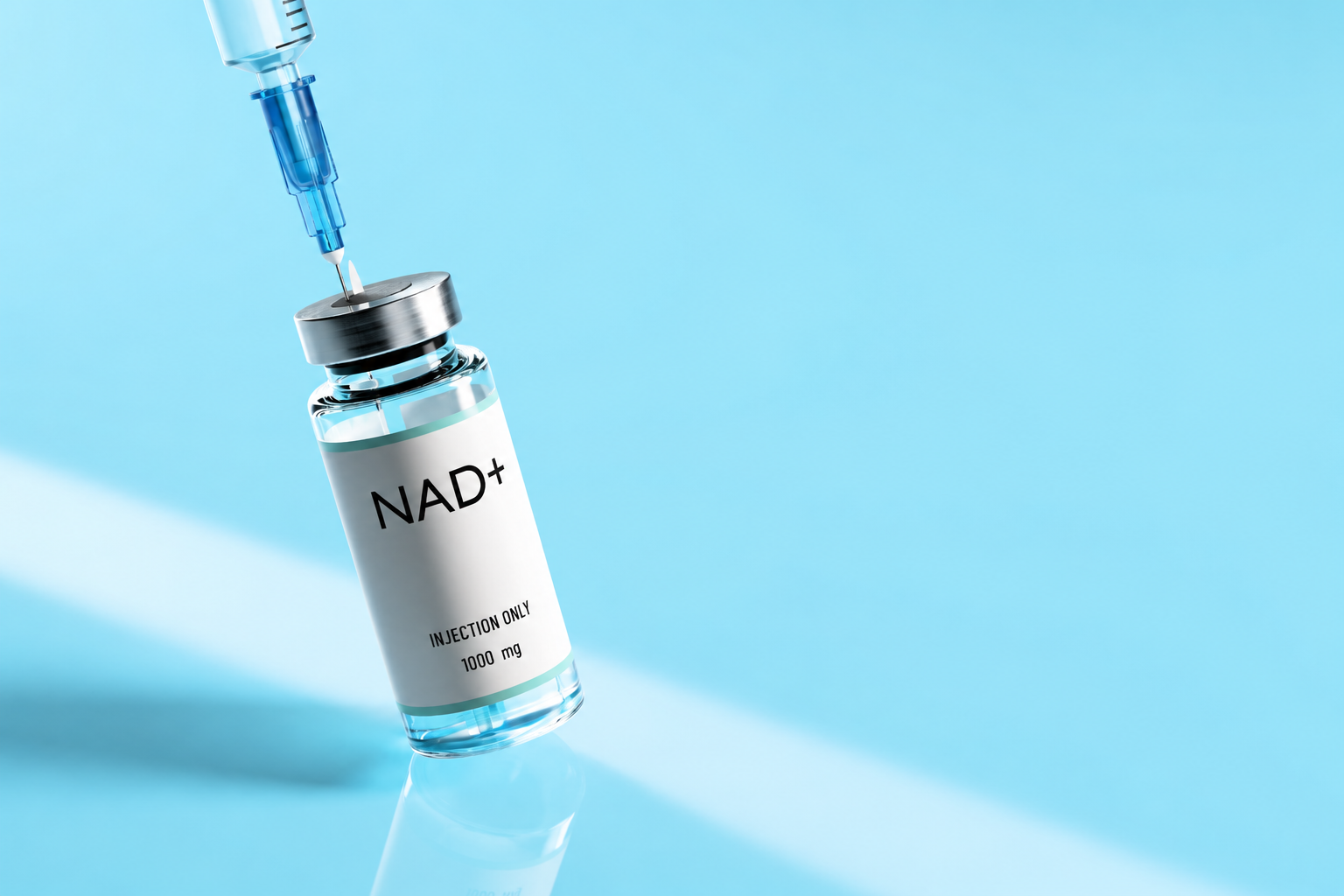
An NAD+ injection generally refers to delivering a solution through a needle, commonly through an intramuscular or subcutaneous route depending on the formulation and clinical protocol.
An NAD+ infusion, on the other hand, involves administering a solution intravenously over a period of time.
The key difference is the route and rate of administration.
Injections
- Typically administered relatively quickly
- Require considerably less time than an IV infusion
- May be more convenient depending on the treatment protocol
- Require appropriate medical guidance and administration
Infusions
- Delivered directly into the bloodstream
- Usually administered gradually over an extended period
- Require IV access and clinical supervision
- Have been studied more extensively than intramuscular NAD+ administration
Importantly, research directly comparing injectable and infusion-based NAD+ protocols remains limited. A small human pharmacokinetic study of IV NAD+ found that plasma NAD+ increased during a six-hour infusion, but research into the clinical significance of these changes is still developing.
What Happens When NAD+ Is Administered?
NAD+ participates in numerous cellular reactions, particularly those involved in energy metabolism and maintaining cellular homeostasis.
The body also continuously synthesizes and breaks down NAD+. This means that simply increasing NAD+ availability does not automatically translate into a specific health or longevity outcome.
This distinction is important.
Research has demonstrated that NAD+-related interventions can influence NAD+ metabolism and related biomarkers. However, the question of whether these changes consistently produce meaningful improvements in human health, physical performance, or longevity remains under investigation.
For injectable NAD+, the evidence base is particularly limited. Most clinical research involving NAD+ restoration has focused on NAD+ precursors such as nicotinamide riboside (NR) and nicotinamide mononucleotide (NMN) rather than NAD+ itself.
Potential Benefits of NAD+ Injections
The interest in NAD+ therapy largely comes from the molecule’s fundamental role in cellular biology.
Researchers are investigating NAD+ and NAD+ precursors in connection with:
- Cellular energy metabolism
- Mitochondrial function
- DNA repair pathways
- Cellular stress responses
- Metabolic health
- Healthy aging
- Age-related changes in cellular function
However, it is important to distinguish biological potential from clinically proven outcomes.
While laboratory and animal studies have generated considerable interest, human clinical trials have produced more mixed results. Current research supports continued investigation, but it does not establish NAD+ injections as a proven treatment for aging-related diseases or as a guaranteed method of extending lifespan.
How Much Do NAD+ Injections Cost?
The cost of NAD+ therapy can vary considerably depending on the provider, formulation, concentration, administration method, location, and treatment protocol.
For this reason, there is no single standard price for NAD+ injections.
When evaluating NAD+ products or therapies, cost should not be the only consideration. Consumers should also consider:
- Product quality and manufacturing standards
- Ingredient identity and concentration
- Appropriate storage and handling
- Testing and quality-control procedures
- Administration requirements
- Clinical supervision where appropriate
At Lumana Bio Labs, our focus is on research-driven products and transparent information so customers can make informed decisions about the science behind NAD+ and related compounds.
NAD+ Precursors: NMN and NR
Another important area of NAD+ research involves NAD+ precursors.
Rather than administering NAD+ directly, compounds such as NMN (nicotinamide mononucleotide) and NR (nicotinamide riboside) can participate in the body’s pathways for NAD+ biosynthesis.
Human studies have shown that oral NMN and NR can increase NAD-related biomarkers, although the magnitude of the effect and its clinical significance can vary between individuals and studies.
NMN has received particular attention in recent years. Clinical trials have generally reported that NMN can increase NAD+ concentrations and appears to be well tolerated over the study periods investigated. However, evidence for broader anti-aging or longevity benefits remains limited and requires larger, longer-term studies.
The same principle applies to NR. Research supports its ability to influence NAD+ metabolism, but researchers are still working to determine which populations, doses, formulations, and treatment strategies provide meaningful clinical benefits.
Are NAD+ Injections the Next Big Thing?
NAD+ is certainly one of the most interesting areas of current longevity and cellular-health research.
But science is more valuable when it is approached with appropriate skepticism.
At present, there is strong biological interest in NAD+ and growing evidence that NAD+ precursors can influence NAD+ metabolism in humans. At the same time, evidence for meaningful anti-aging and longevity outcomes remains incomplete, particularly for direct NAD+ injections. A 2026 systematic review found that human studies consistently demonstrate biochemical changes with oral NR and NMN, while clinical outcomes have been heterogeneous; it also noted the lack of eligible trials demonstrating anti-aging or wellness outcomes from intravenous or intramuscular NAD+ itself.
That means NAD+ should be viewed as an emerging area of research, rather than a proven shortcut to longevity.
The Future of NAD+ Research
The science surrounding NAD+ is evolving rapidly.
Researchers are continuing to investigate how NAD+ metabolism changes with age, how different NAD+ precursors are absorbed and utilized, and whether targeted NAD+ interventions can produce meaningful improvements in human health.
Future research will need to answer several important questions:
- Which NAD+ interventions are most effective?
- Which delivery methods provide the most consistent results?
- What doses are appropriate for different individuals?
- How long do changes in NAD+ levels persist?
- Which health outcomes can actually be improved?
- What are the long-term effects of sustained NAD+ augmentation?
These questions matter because increasing a biological marker is not necessarily the same as improving health.
At Lumana Bio Labs, we believe the future of biotechnology should be built around quality, transparency, scientific curiosity, and responsible research.
NAD+ may ultimately become an important component of healthy-aging strategies. But the most valuable discoveries will come from rigorous research that separates promising possibilities from proven outcomes.
Lumana Bio Labs — Advancing the Science of Cellular Health
Explore our research-focused approach to NAD+, NMN, NR, and other compounds being investigated in the rapidly evolving field of longevity science.
Important: The information provided in this article is for educational and research purposes only. It is not intended to diagnose, treat, cure, or prevent any disease and should not be considered medical advice. Injectable products should only be used in accordance with applicable laws, professional guidance, and the specific product’s labeling and instructions.